
Insights
Falling asleep is one of the most universal human needs — yet for many, it’s one of the hardest to fulfill. Around one in three adults worldwide experience sleep latency, struggling to quiet the mind and relax the body at the end of the day. Through interviews, co-creation sessions, and sleep diaries, we discovered that people don’t just want silence; they seek reassurance, presence, and calm. Many described the emotional toll of lying awake for hours, trapped between fatigue and wakefulness.
Our exploration into Autonomous Sensory Meridian Response (ASMR) — sometimes called auto sensory meridian response — revealed a fascinating link between sound, touch, and emotion. ASMR is a sensory experience that produces a tingling sensation beginning on the scalp and moving down the neck and spine. Often described as low-grade euphoria, it combines positive feelings with a subtle, static-like tingling that relaxes the body and eases tension.
This phenomenon is most commonly triggered by gentle auditory or visual stimuli — such as whispering, tapping, or rhythmic brushing — that create a sense of comfort and closeness. Our research showed that these triggers can lower heart rate, reduce anxiety, and help listeners reach a state of relief and presence. This connection between sound and physical response became the foundation of our design approach: using audio as a form of physical comfort to help the mind release tension and drift naturally into sleep.
Solution
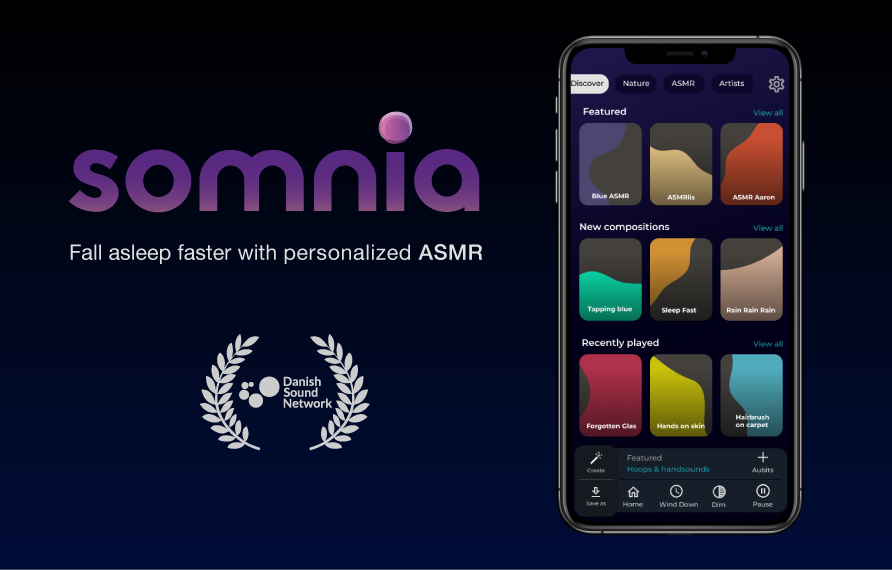
Somnia was designed as an audio-first experience that shortens the path between wakefulness and rest. The app allows users to explore and personalize ASMR-inspired soundscapes, blending layered whispers, tapping, and low-frequency tones that gradually evolve as the listener relaxes. Each session is built to evoke calm, slow down the body, and create the conditions for natural sleep — without screens, medication, or mental effort.
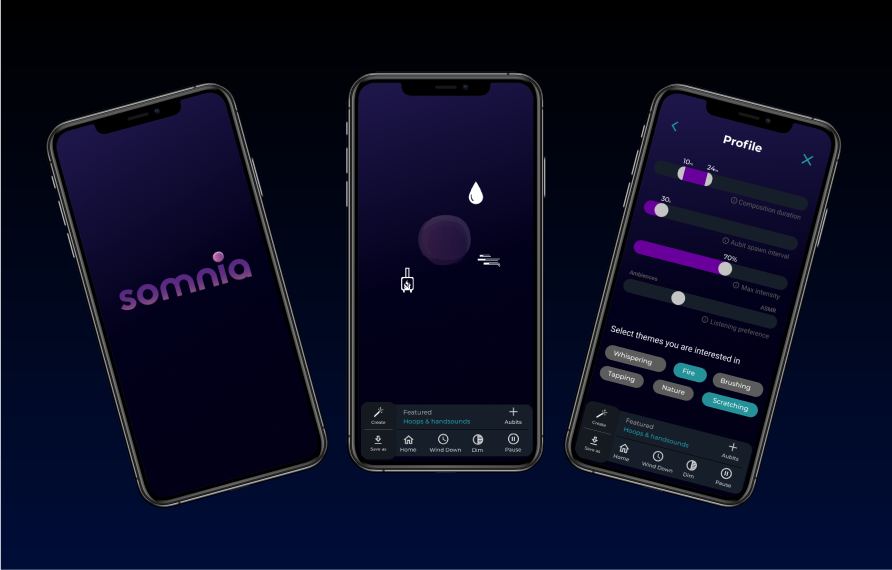
To bring this idea to life, we created a dynamic sound system that lets users either compose their own soundscapes or explore curated experiences. Based on extensive research, our audio designers reproduced thousands of ASMR-triggering sounds — from rain and wind to thunder and soft motion — all recorded and processed in high fidelity. These were then broken into micro sound units, or “aubits”, which are reconstructed in real time, allowing the soundscape to constantly evolve and remain fresh.
The sounds are projected in 3D spatial audio around the listener’s head, creating the sensation of a living, breathing environment that supports deep relaxation and presence. The interface is deliberately minimal and unobtrusive, using a dark palette, soft motion, and single-tap interactions to reduce stimulation and cognitive load.
More than an app, Somnia became a tool for presence — a bridge between science and emotion, reminding users that falling asleep can once again feel effortless, natural, and human.
The design process for Somnia was a deeply exploratory journey — a fusion of
behavioral research, creative experimentation, and
sensory testing that unfolded through cycles of insight,
prototyping, and emotional validation. I immersed myself in
psychology and ASMR communities to understand the emotional and
physiological barriers to falling asleep, collaborating closely with
people living with sleep latency, ASMR artists, and
sleep specialists to define what “relaxation through sound” could truly feel like.
Together, we built and tested dozens of sound and interaction prototypes using
binaural audio, spatial diffusion, and
subtle haptic illusions to evoke calmness and
sensory immersion, while monitoring sleep patterns through
wearable devices and user feedback to evaluate effectiveness.
Through continuous refinement, we created a minimal, atmospheric interface that supports the
auditory journey without distraction. At its core, this process prioritized
emotional usability — designing not just for what people could do, but
how they felt while doing it.
As UX Lead, my contributions to Somnia spanned from research and creative direction to experience design and validation. I translated behavioral insights and ASMR principles into an emotionally engaging digital experience that encouraged relaxation and trust. Working with sound artists, sleep specialists, and users with sleep latency, I led the creation and testing of immersive audio prototypes that blended rhythm, tone, and psychoacoustic layering to simulate physical stimulation and calm the mind. I guided the design of a minimal, sensory-focused interface that emphasized predictability, warmth, and ease, while integrating feedback from continuous testing and sleep-pattern monitoring. Acting as the bridge between creative exploration and scientific understanding, I aligned the multidisciplinary team around a shared vision — transforming sound and human behavior into a meaningful, human-centered design that helped users reconnect with rest.
Awards
- We were so honoured and happy to win the Danish Sound Startup Award 2018 given by the "Danish Sound Network".
Alicia Torres
- I'm super impressed. When you first download the app it asks you a couple of questions about your preferences. Then it immediately starts playing a perfect blend of sounds tailored to you!